|
|||||
 |
|||||
|
|||||
|
Timing Disaster
The September issue of the Canadian MoneySaver contained an avalanche of articles that encouraged investors to time the market. These interesting approaches sparked my memory. I recently had the pleasure of reading Charles Ellis' book Classics: An Investor's Anthology (1) which contains Robert Jeffrey's article The Folly of Stock Market Timing (2). The article included a startling figure showing the impact of market timing based on a simple strategy. I've updated his analysis in order to provide a cautionary tale to potential market timers. Consider making a simple choice each month. You can either stay in the market as represented by the S&P500, or switch into 1-year treasury bills. The buy-and-hold investor will simply remain in the S&P500 for as long as possible. The market timer hopes to do better by switching out of stocks during market declines and back into stocks during bullish periods. We will focus on two market timers. The first is a prescient investor who is able to flawlessly pick the asset (treasury bills or the S&P500) which performs the best every month. On the other hand, his poor cousin has a knack for invariably selecting the asset that falls the most every month. Each month our market timers look into their crystal ball and place their bets. Should they decide to switch from stocks to bills it will cost them 1% in brokerage fees, market impact costs and crystal ball maintenance. Let's look at the historical record to see how our investors would have fared from January 1926 to April 2001 (3). During this period the inflation-adjusted performance of treasury bills, the S&P500 and our two market timers is shown in Figure 1. The top line represents the results achieved by the perfect market timer and the bottom line those experienced by the worst market timer. The annualized real return of treasury bills was 0.7% for the period and the S&P500 posted annual gains of 7.6%. Not surprisingly, the best market timer did quite well with a 24.8% annualized return. On the other hand, the poor market timer saw his wealth shrink at an annual rate of 22.3%. 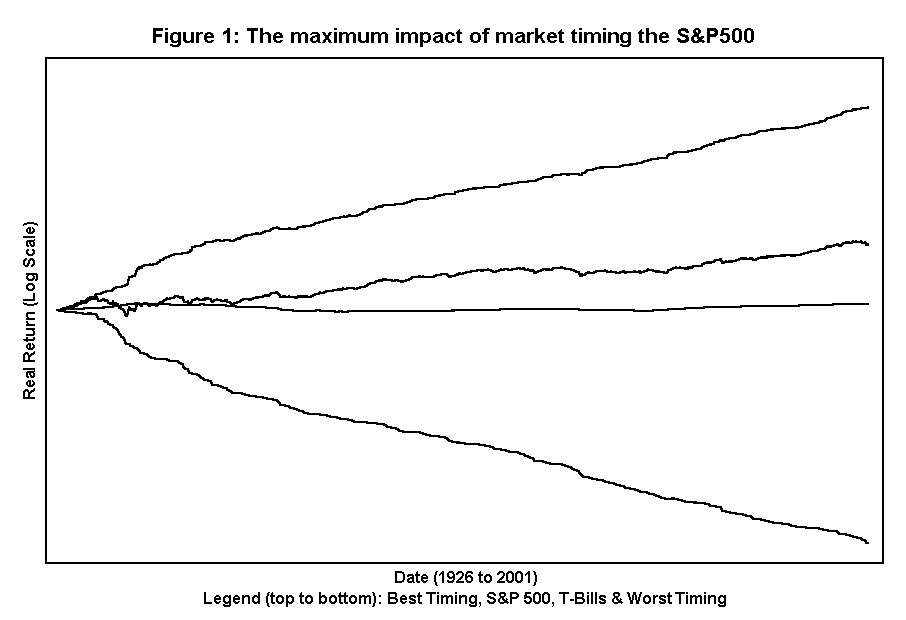
It is useful to look at the potential upside and downside of market timing compared to simply buying and holding the S&P500. The S&P500 returned an average of 7.6% and the best timer did 17.2% better than that. Not bad! However, the penalty for poor timing is 29.9% worse than the simple buy-and-hold approach. In other words, the potential downside of market timing was 1.74 times or 73.8% larger than its potential upside. The downside of market timing becomes even larger when taxes are included. Now a 1% trading cost may not be realistic for all investors. Large accounts and institutional investors should be able to do better. However, modest accounts may experience higher costs. Also, although market timing becomes less disadvantageous as commissions are reduced it never becomes advantageous. Even without commissions the marginal gain from the best timing strategy was less than the marginal loss from the worst timing strategy. Let's look at the situation differently. The chance of the S&P500 outperforming treasury bills on a monthly basis from 1926 to 2001 was 58.7%. So, on average, switching from the S&P500 to treasury bills was a bad move 58.7% of the time. Include commissions and the probabilities get worse. With a 1% commission the chance of a bad switch was 62.3% and with a 2% commission the chance of a mistake was 74.4%. A 74.4% chance of being wrong is very hard to overcome on a consistent basis. Does theory reflect reality? When it comes to mutual funds there is ample evidence of poor timing by U.S. investors. In the 1995 edition of The Journal of Portfolio Management, Stephen Nesbitt showed that fund investors lost about 1% a year by switching funds at the wrong time. More recently the June 2002 issue of Money magazine contained an article by Jason Zweig called What Fund Investors Really Need To Know. In Jason Zweig's study a fund's posted performance was compared to that earned by the fund's average investor over the last 4 years. The results were shocking. While the average U.S. mutual fund earned 5.7% annually from 1998 to 2001, the average fund investor earned just 1%. Poor timing reduced returns by 4.7%. It would appear that in practice, market timing is detrimental to one's wealth. Although timing is bad for our portfolios, we must all be market timers to some extent. Most of us start life with little money and must collect it over time in anticipation of spending a bit before passing on. Given the odds against beneficial market timing I suggest practicing it only at the margins. For instance, after earning more money one can time a new purchase. If we expect to require funds then we can time our exit. Waiting a month or two shouldn't make a huge difference. However, changing an entire portfolio on a regular basis is likely to cause more grief than joy. Footnotes: 1 ISBN 1556230982 2 Harvard Business Review, July-August 1984 3 Source: TAM Asset Management First published in October 2002. |
|||||
| |||||
| |||||
| Disclaimers: Consult with a qualified investment adviser before trading. Past performance is a poor indicator of future performance. The information on this site, and in its related newsletters, is not intended to be, nor does it constitute, financial advice or recommendations. The information on this site is in no way guaranteed for completeness, accuracy or in any other way. More... | |||||