|
|||||
 |
|||||
|
|||||
|
Just Spend It
I was recently asked by Jonathan Chevreau to make a few suggestions on what, given the times, should be done with a $10,000 windfall. An interesting question that is difficult to answer. Nonetheless, in this article I offer a few suggestions and take a look at the vexing choice between spending today and saving for tomorrow. First and foremost the extra $10,000 should be used to pay down debt. I freely admit to being debt phobic and most Canadians can use the $10,000 to reduce their large debt loads. Paying off the mortgage, credit card or margin loans will help to buffer one from life's misfortunes. If there is anything leftover then an emergency fund is a must. At a bare minimum, a 3-month supply of ready cash should be locked away in a high interest bank account. The emergency fund is there to help in case of unemployment, deterioration of health or other disaster. Those who have recently been fired know just how valuable such a cushion is. By this point most Canadians will have used up the entire $10,000 but if there is a bit left over then some should be saved for Christmas cheer. Since most households spend about $1,000 over the Christmas season this seems like an adequate amount to set aside. After all, it is better to pay for Christmas presents with cash than to pay credit card interest in the New Year. With the basics covered, we are down to the fundamental question of what to do with any excess cash. It can be spent now or squirreled away for later and the option of spending is currently quite attractive. One's desires can be immediately fulfilled by spending today and waiting may lessen both the quantity and quality of consumer satisfaction. No, I've not gone off my rocker. I just think that savers will be largely unsuccessful in the next decade. First consider investing in a 10-year government of Canada bond which currently yields about 5.3% and then factor in tax and inflation. A 40% tax rate drops the 5.3% interest rate to 3.2% which is very close to the current 3% inflation rate. The after-tax real return of this investment is only 0.2%. Many investors don't have enough money, or expertise, to buy bonds directly and will opt instead for a solid bond fund such as that offered by PH&N. Regrettably, the PH&N bond fund charges a yearly fee of 0.58% which makes a positive after-tax real return uncertain at best. A break even return is still better than the current crop of Canadian Savings Bonds which yield 3.03%. After tax and inflation the patriotic CSB holder will likely lose 1.2% annually. Historically bonds have been a bust for investors. David Dreman in Contrarian Investment Strategies: The Next Generation showed that the after-tax real return on bonds was about -2% annually for U.S. investors during the 1946-1996 period. Yes, bond investors lost money and would probably have been better off spending their hoard. How about stocks? With lofty equity valuations we are in even more hot water. The S&P500 currently has a price-to-earnings ratio of 28.3 whereas its historical average is about 15 (See Figure 1). Let's assume that in the next decade corporations will grow their earnings in line with real GDP growth of 3%, that inflation will average 3%, that dividends will continue at 1.1% and that the average price-to-earnings ratio will fall from 28.3 to 20. These assumptions would result in a return of 3.7% before tax and inflation. Now consider buying a low-cost index fund that charges a MER of 0.5%. The 3.7% return becomes 3.2% after the MER, then 2.6% after a 20% tax and -0.4% after inflation. A projected -0.4% return for stocks doesn't leave room for mistakes which regrettably investors make with an alarming regularity. Stephen Nesbitt found that U.S. mutual fund investors are poor timers and loose about 1% annually due to buying high and selling low. Taking bad timing into account 3.7% becomes 2.7% due to timing, 2.2% for the MER, 1.8% after tax and -1.2% after inflation. Now consider investing in an equity mutual fund that charges a 2.5% MER and manages to outperform the market by 1% before fees. Starting with a return of 4.7% the 2.5% MER fee comes off the top with 1% more for bad timing leaving 1.2%. Now the taxman leaves this poor investor with 1% but inflation steps in resulting in a -2% return. Are there ways to eke out a positive real return after tax? The odds get better if one follows a cost minimization approach. This means holding stocks for long periods to avoid paying taxes each year and selecting lower cost value oriented securities. However, that may be too much work to justify what is likely to be a break even return. In the end, most Canadians may be better off just spending their excess cash which is an option largely ignored by most financial experts. Perhaps a compromise position is best with spending accounting for half of any excess and savings the other half. This way Canadians can have some fun now and avoid saving too much. After all, none of us are getting any younger. 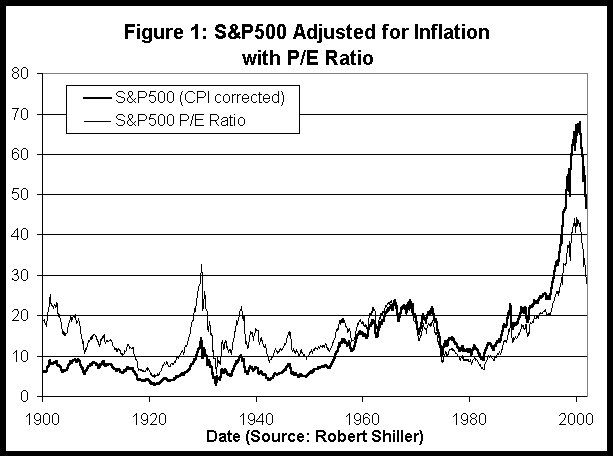 First published in November 2001. |
|||||
| |||||
| |||||
| Disclaimers: Consult with a qualified investment adviser before trading. Past performance is a poor indicator of future performance. The information on this site, and in its related newsletters, is not intended to be, nor does it constitute, financial advice or recommendations. The information on this site is in no way guaranteed for completeness, accuracy or in any other way. More... | |||||